
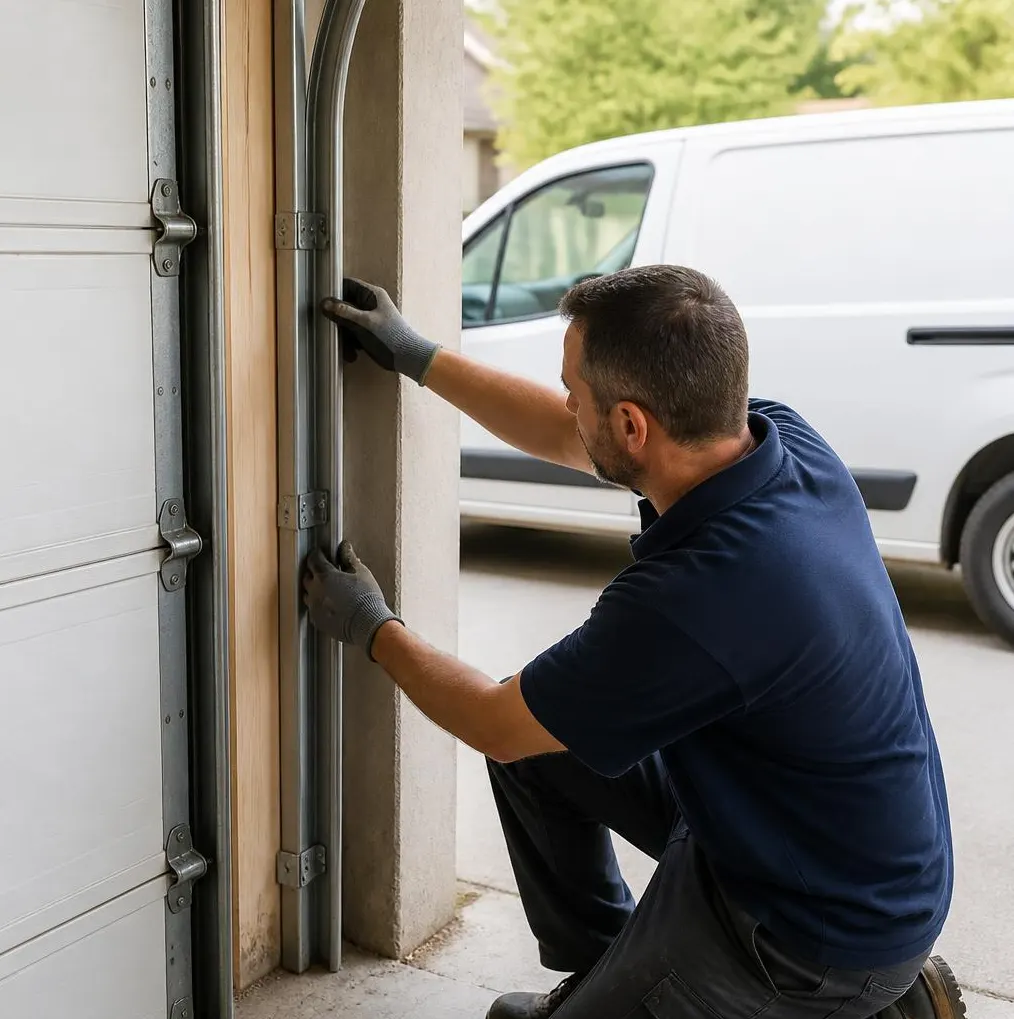
Rule of thumb: if your garage door is slow or stubborn on a cold morning, the odds favor stiff lubricant and cold-tightened hardware over actual ice. The exceptions are real, though — a hard freeze right after rain, or an overnight frost following one of Montgomery's heavy afternoon downpours, can leave the bottom seal genuinely frozen to the slab. Both situations look similar from the kitchen window, but they call for different fixes, and forcing the wrong one can turn a minor annoyance into a broken spring or a cracked panel.
What You'll Notice First
- The opener strains or clicks but the door doesn't move — you'll hear the motor working harder than usual, sometimes followed by a reversal.
- The door moves an inch or two, then stops — often with a tearing or cracking sound as a seal lets go.
- Visible frost or a thin ice sheet along the bottom weatherstripping where it meets the concrete.
- The door opens, but slower and noisier than normal — a dragging sound from the tracks or a grinding note from the rollers.
- One side lags behind the other, so the door looks slightly crooked as it travels.
None of these symptoms tell you the cause on their own — that's why a technician works through them in a specific order, cheapest and most obvious first.
Check 1: Is the Seal Actually Frozen to the Ground?
This is the fastest thing to rule in or out, so it's checked first. Look closely at the bottom seal. If you see a thin layer of ice fusing the rubber to the slab, that's your answer — and it's common here precisely because Montgomery's humidity keeps that rubber seal damp most of the year. When a rare freeze follows a wet stretch, that trapped moisture is what ices over, not the door itself.
The fix: Never run the opener repeatedly trying to break it loose — that's how torsion springs get overstressed. Instead, warm the seal gently with a hair dryer or a bucket of warm (not boiling) water, then free it by hand with a flat tool before testing the opener again. Skip rock salt directly on the seal; it degrades rubber over time and isn't necessary for a one-time thaw.
Check 2: Tracks and Rollers
If there's no ice, the next stop is the track. Cold thickens standard grease into something closer to wax, which drags on the rollers. In older Montgomery homes, you'll often find actual rust pitting here too, a result of years of humidity swings rather than the cold snap itself — the cold just reveals the problem by making the binding worse.
The fix: Clean the tracks with a dry cloth, then apply a garage-door-specific lithium or silicone-based lubricant — not WD-40, which is a solvent and won't hold up as a long-term lubricant. Nylon rollers that have gone flat-sided or steel rollers with visible rust pitting should be replaced rather than just oiled.
Check 3: Springs
Metal contracts slightly in the cold, and a torsion spring that was already near the end of its life cycle can feel noticeably stiffer on a frigid morning. This is also where repeated forcing from the first two issues does the most damage — a seal that's stuck or a roller that's binding puts extra load on the spring every time someone hits the opener button anyway.
The fix: Spring tension adjustment or replacement is not a DIY job — these are under extreme tension and can cause serious injury. If the door feels unusually heavy when lifted manually (with the opener disconnected), that's the signal to stop and call for spring service rather than keep cycling the opener.
Check 4: Opener Force Settings
Cold affects chain and belt tension slightly, and an opener's logic board reads any extra resistance — from a stiff roller, a tight chain, or a half-frozen seal — as an obstruction and reverses the door. Homeowners sometimes assume the opener itself is failing when really it's doing exactly what it's programmed to do.
The fix: Once the mechanical issues above are addressed, the force and limit settings often need a small recalibration. This is a quick adjustment but easy to get wrong without the right reference points, since too much force defeats the opener's safety reversal feature.
Check 5: Weatherstripping and Panel Condition
Last on the list because it's the least likely to cause a full stall, but worth checking if the door is only sluggish rather than stuck: weatherstripping that's absorbed moisture over a humid summer can swell and start catching on the threshold track as temperatures drop. On older wood-paneled doors, the same swell-and-shrink cycle can leave panels slightly misaligned, which shows up as extra drag or a door that looks crooked mid-travel.
The fix: A worn or swollen bottom seal is a straightforward replacement. Panel misalignment on a wood door may need realignment of the hinges or, if the wood has warped, a panel swap.
When to Call Montgomery Garage Door Pro
If the door won't release without force, you hear a bang or crack when it finally moves, or the opener keeps reversing no matter how many times you try, stop troubleshooting and call us. Those are signs the spring or opener logic needs a trained eye, not more button-pressing. We handle Spring Repair & Replacement for doors that have gone stiff or heavy, and our Garage Door Maintenance visits catch the rusted rollers and swollen seals before the next cold snap turns them into a stuck door at 6 a.m.
If your garage door is fighting you on these cooler mornings, give Montgomery Garage Door Pro a call — we serve Montgomery, Prattville, Wetumpka, Millbrook, Pike Road, Deatsville, Tallassee, and Elmore, and we can usually get a technician out the same day to sort out what's really going on.