
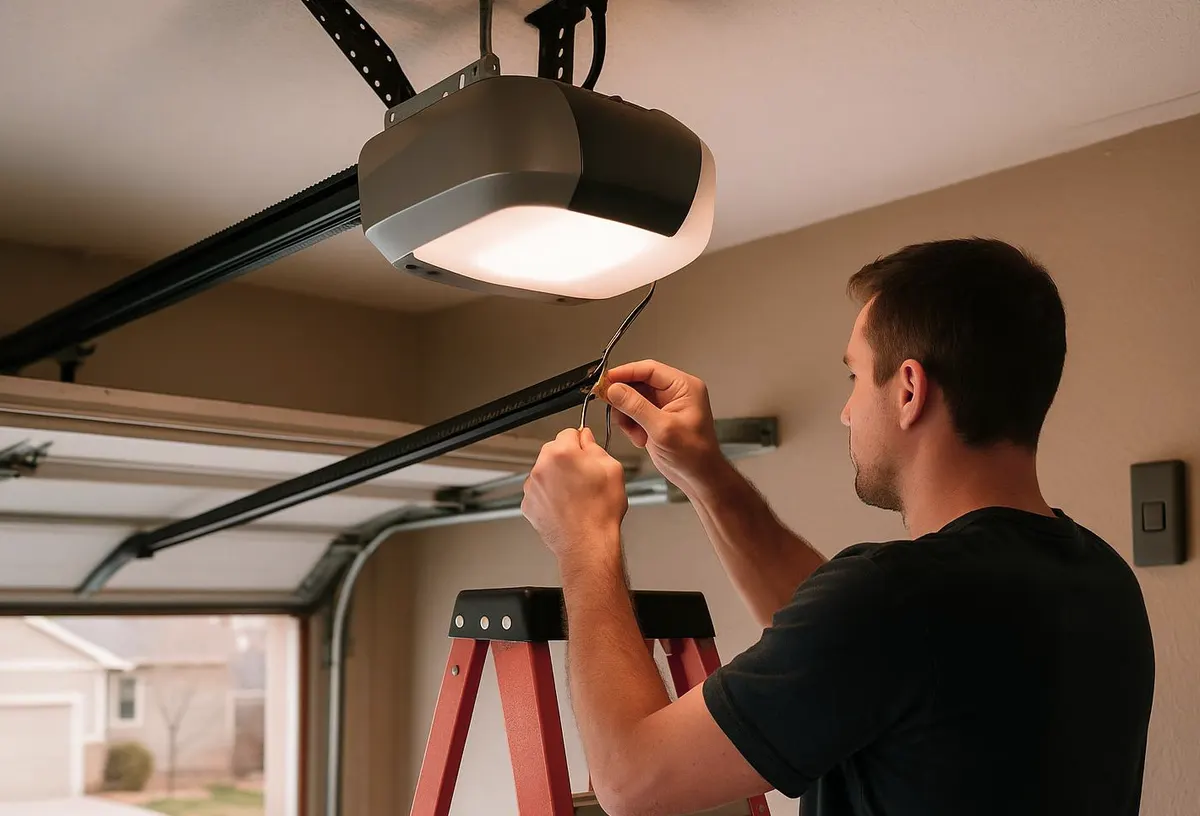
What a Technician Sees on These Calls
A typical service call starts the same way: a door that squeals going up, grinds coming down, and an owner who swears they "just oiled it last month." Nine times out of ten, the culprit is the wrong product in the wrong spot. We find WD-40 caked with grit on hinges, motor oil dripping down the track onto the concrete, or thick grease packed onto nylon rollers where it has no business being. In this part of Alabama, humidity and afternoon downpours speed up the damage. Moisture gets into unprotected metal, light lubricants evaporate fast, and whatever's left behind turns into a sticky trap for dust and pollen. The fix isn't more lubricant — it's the right lubricant, applied in the right places, on a schedule that matches the climate.
Tools and Products You'll Need
- Silicone-based garage door lubricant spray (the single best all-purpose choice)
- White lithium grease (for springs and heavier-duty contact points)
- Clean microfiber rags
- A soft brush or old toothbrush for cleaning hinges and rollers before lubricating
- A stepladder
- Safety glasses
- A shop vacuum or stiff brush for clearing track debris
Step-by-Step: Lubricating Your Garage Door
- Disconnect the opener. Pull the manual release cord so the door is free to move by hand. This keeps you from fighting the motor while you work and lets you test smoothness afterward.
- Clean before you lubricate. Wipe down tracks, hinges, and rollers with a dry rag to remove dirt, pollen, and old residue. Lubricating over grime just creates a paste that grinds the hardware instead of protecting it.
- Inspect as you go. Look for rust spots on hinges and springs, flat spots or cracks on rollers, and any hardware that's loose. Note anything that looks bent, frayed, or heavily corroded — that's not a lubrication job, that's a repair call.
- Lubricate the hinges. Give each pivot point a light spray of silicone lubricant, working the door up and down a few inches to let it soak into the joint. Wipe off anything that drips.
- Lubricate the roller bearings, not the wheels. If you have steel rollers, lightly spray the bearing at the center. If you have nylon rollers, use lubricant sparingly on the bearing only — never coat the nylon surface itself, since grease there attracts debris and can make the roller slip in the track.
- Coat the springs. Apply a thin layer of white lithium grease or a silicone spray along the coils. Springs take the most mechanical stress on the door and are also first to show rust after a stretch of humid weather, so this step matters most heading into storm season.
- Lubricate the opener's chain or screw drive. Use a lubricant made for that opener type — check your manual. A light, even coat is enough; pooling oil just attracts dust.
- Keep the tracks dry. Never spray lubricant directly into the tracks. They need to stay clean and dry so the rollers glide instead of slip. If the tracks look dirty, wipe them with a dry cloth, not oil.
- Cycle the door by hand. Raise and lower it a few times manually, listening for grinding or squeaking that didn't go away. That's often a sign of a worn part rather than a dry one.
- Reconnect the opener and test. Run it through a full open-close cycle and watch for smooth, even movement on both sides.
Products to Avoid
- WD-40 as a long-term lubricant. It's a solvent and water-displacer, not a lubricant. It evaporates quickly, especially in the heat, leaving parts dry again within days and often attracting more dust in the meantime.
- Motor oil or household 3-in-1 oil. Too thin to stay put, it drips onto tracks and the garage floor and picks up grit fast.
- Heavy grease on nylon rollers or inside the track. It builds up, hardens, and makes the door work harder than it should.
Where DIY Ends and a Technician Should Take Over
Lubrication is homeowner territory. Spring tension, cable replacement, and track alignment are not. If a spring is rusted, stretched, or looks uneven compared to its pair, don't try to adjust or remove it — the tension stored in a garage door spring can cause serious injury. Likewise, if rollers are cracked, the track is bent, or the opener's gears are worn, lubricant won't solve the underlying problem and can mask a failure that's close to happening.
When to Call Montgomery Garage Door Pro
If you've gone through this routine and the door still binds, sags, or makes noise, it's time for a proper look. Our Garage Door Maintenance visits cover a full inspection of springs, cables, rollers, and hardware condition, not just a quick spray-down — useful heading into hurricane season when wind-load hardware needs to be in top shape. If a spring shows rust-through or uneven wear, our Spring Repair & Replacement service handles it safely with the right tension and parts rated for the load your door carries.
If your garage door needs more than a lubrication session, call Montgomery Garage Door Pro. We serve homeowners and businesses throughout Montgomery, Prattville, Wetumpka, Millbrook, Pike Road, Deatsville, Tallassee, and Elmore, and we're ready to get your door running smooth before the next round of Alabama weather hits.